

By Tanguy Duthion
·
April 17, 2026
DORA (Digital Operational Resilience Act) applies to financial entities and critical ICT providers operating in the EU, with supervisory expectations around continuous resilience — not “compliance on paper.” Industry estimates often cite tens of thousands of in-scope entities and material ICT providers; penalties can reach up to €10M or 2% of worldwide annual turnover (whichever is higher), depending on the case and legal basis.
Tools like Avanoo help teams operationalize inventory and governance: detect Shadow IT / Shadow AI and align evidence collection with NIS2 and DORA expectations.
Why it matters: DORA is not only about fines — it’s about keeping critical services available under stress and demonstrating defensible oversight to supervisors and customers.
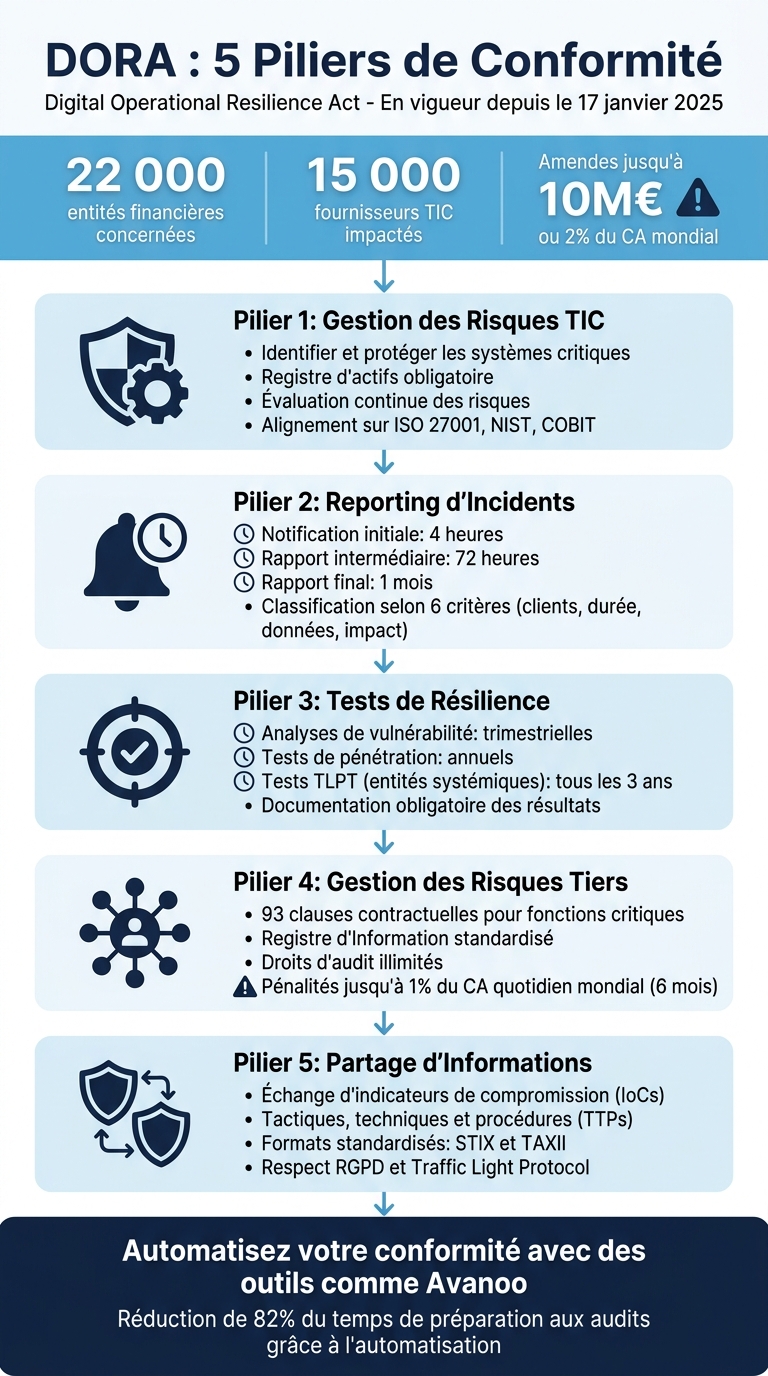
DORA expects a closed-loop ICT risk framework: identify, protect, detect, respond, recover — and review after major incidents, architecture changes, or threat shifts.
Start by mapping critical/important business functions to the ICT assets that support them — including cloud and “non-standard” SaaS that never went through architecture review. DORA pushes organizations toward a standardized register of ICT assets and third-party arrangements.
For vendor criticality, use supervisory criteria (impact, substitutability, substitutability constraints) and define RTO/RPO targets for essential systems.
Anchor your program to credible baselines (ISO 27001, NIST CSF, COBIT) and run a BIA that ties downtime scenarios to euros/minutes — not vague “high/medium/low” labels.
Governance isn’t a staff-only exercise: DORA emphasizes board-level ownership of ICT risk policy and tolerance.
Use SIEM and APM where appropriate, but don’t confuse tooling with outcomes: the goal is timely detection, traceability, and audit-ready records. Automated evidence collection can dramatically reduce audit prep time — if the underlying inventory stays current.
DORA’s incident lifecycle is designed for consistency across the EU. Practically, you need classification, communications, and forensic discipline that start immediately — not after legal spends a weekend debating definitions.
A major incident is typically evaluated using supervisory criteria (often based on thresholds like customers affected, duration, geography, data impact, economic impact, service criticality). Many frameworks also treat recurrent minor incidents with a common root cause as major when they repeat within a window.
Your playbooks should include: crisis team roles (IT, legal, risk, comms), decision rights, forensic preservation, regulator notification templates (including identifiers like LEI where required), and customer/partner messaging discipline.
For French operations, coordinate with national authorities as applicable (ACPR, CNIL, ANSSI) alongside EU-level processes.
DORA distinguishes baseline resilience testing and TLPT for systemic entities. The point is not “more pentests” — it’s a program with prioritized scope tied to critical functions, remediation tracking, and board visibility.
Your register should connect assets to critical functions, include fourth-party dependencies where relevant, and survive scrutiny — poor register quality is a common supervisory finding in pilot reporting exercises.
Many programs run quarterly vulnerability scanning on critical systems, annual penetration testing / scenario exercises, and TLPT on the supervisory cadence for in-scope entities. Validate major releases with secure SDLC reviews.
Each test should produce methodology, findings, remediation owners, and deadlines — stored in the ICT risk system and escalated to management with measurable closure.
Evaluate data volume, service criticality, failure impact, security posture evidence (SOC reports, ISO), incident history, and concentration (single points of failure across the market).
DORA raises the bar for contractual content on critical ICT services: SLAs, audit rights, data location, assistance during incidents, and exit/transition assistance. Many teams implement DORA addenda rather than renegotiating entire estates overnight.
| Contract element | Why it matters |
|---|---|
| SLAs + RTO/RPO | Makes resilience measurable |
| Audit / inspection | You cannot govern what you cannot verify |
| Data location + transfers | GDPR + operational reality |
| Exit + transition | Prevents hostage renewals |
| Incident cooperation | Clear runbooks reduce clock risk |
Run service monitoring, periodic reassessment, and supply-chain mapping (including nth-party dependencies). Update the register when vendors change — and at least annually even if “nothing changed” (something always changed).
Article 45 enables sharing of IOCs, TTPs, and alerts in trusted communities — with GDPR and competition-law guardrails. Operationalize TLP-style handling, validate IOCs before distribution, and use standards like STIX/TAXII where possible.
Platforms like MISP and SOAR integrations help operational teams convert intelligence into action — without turning sharing into accidental data leakage.
Financial IT teams need continuous inventory, automated evidence, and supplier visibility — especially where SaaS and AI adoption outpaces traditional CMDB hygiene.
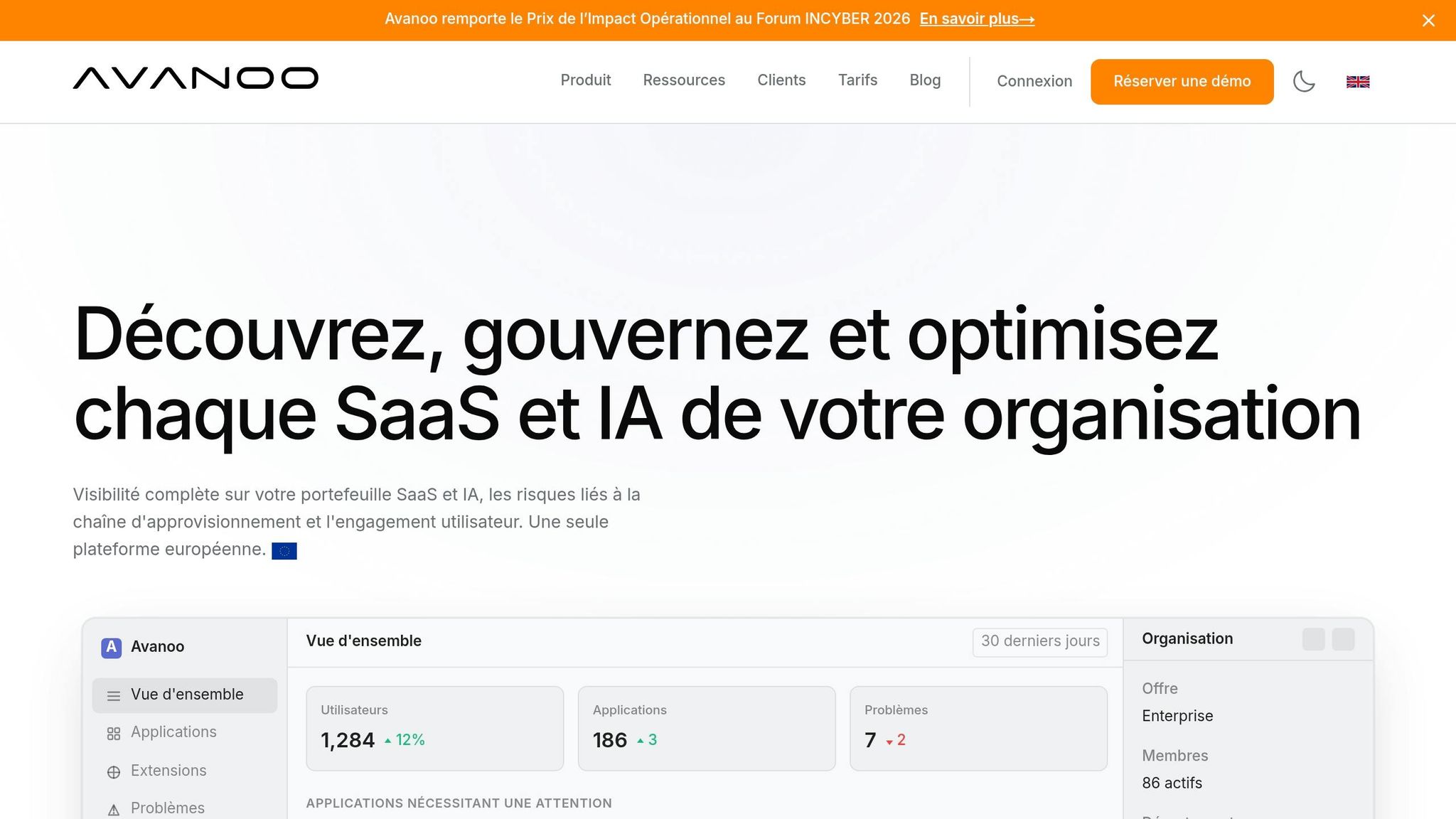
Avanoo helps European organizations discover what is actually used — including Shadow IT and unauthorized AI tools — and consolidate an evidence-friendly inventory quickly (typically <15 minutes to first integrated view with standard connectors).
"We discovered 214 AI tools in use. We only knew about 7. Avanoo gave us the clarity to act." — Thomas D., IT security lead, European bank
EU hosting options support sovereignty expectations for sensitive assessments — pair technical discovery with your legal/procurement register to close the DORA “unknown ICT” gap.
| Capability | Basic | Professional | Enterprise |
|---|---|---|---|
| Shadow IT detection | Yes | Yes | Yes |
| Shadow AI discovery | Limited | Full | Full |
| Supply-chain mapping | No | Baseline | Advanced |
| DORA / NIS2 modules | No | Yes | Yes |
| Browser nudges / surveys | No | Yes | Yes |
DORA turns resilience into a management system: ICT risk, incidents, testing, third parties, and intelligence sharing are mutually reinforcing — not five separate projects.
"The essence of DORA is strengthening the financial sector’s digital resilience as ICT disruption and cyber threats accelerate." — Danielle Barbour, Kiteworks (paraphrased public statement)
If you start anywhere, start with truth in inventory — because every other control depends on knowing what runs in production, who owns it, and what happens when it fails.
Run a gap assessment against DORA expectations, then build a minimum viable inventory (apps, infra, critical vendors, owners, RTO/RPO). Expand iteratively — perfection is not a prerequisite for progress.
Automate evidence: risk assessments, incident timelines, test reports, vendor reviews, and change records. Auditors reward repeatable processes and traceability, not slide decks.
Supervisors look at dependency, substitutability, concentration, and impact on the financial system — not at your internal “tier 1 / tier 2” label alone.

Co-fondateur & CEO
Tanguy Duthion is co-founder and CEO of Avanoo. Previously at Google and Asana, he founded Avanoo to help organizations regain control over their SaaS and AI usage.
See how Avanoo can map your SaaS and AI landscape, reduce risk, and optimize costs. A reliable platform with dedicated human support.
