

By Olivia Dubois
·
August 15, 2026
Yes: one compromised supplier can hit several French websites at once. If you rely on third-party scripts, a SaaS tool, a hosting provider, or a web agency, you may be exposed even when the flaw is not on your own website.
I would keep four simple points in mind:
A few figures set the scene: WordPress powers 43.1% of websites worldwide, and 22,400 WordPress sites were used to host phishing pages between May and July 2023. On the JavaScript side, malicious npm packages jumped by 451% year on year, with 177,000 new packages detected in 2025.
Put simply, if I manage a website in France, I need to look beyond my own code: my suppliers are part of my exposure surface. This article explains where an attack can enter, which signals to monitor, which rules apply, and what to do if several sites are affected through the same provider.
:::: @iframe https://www.youtube.com/embed/HTlfM8yra5g :::
:::: @figure 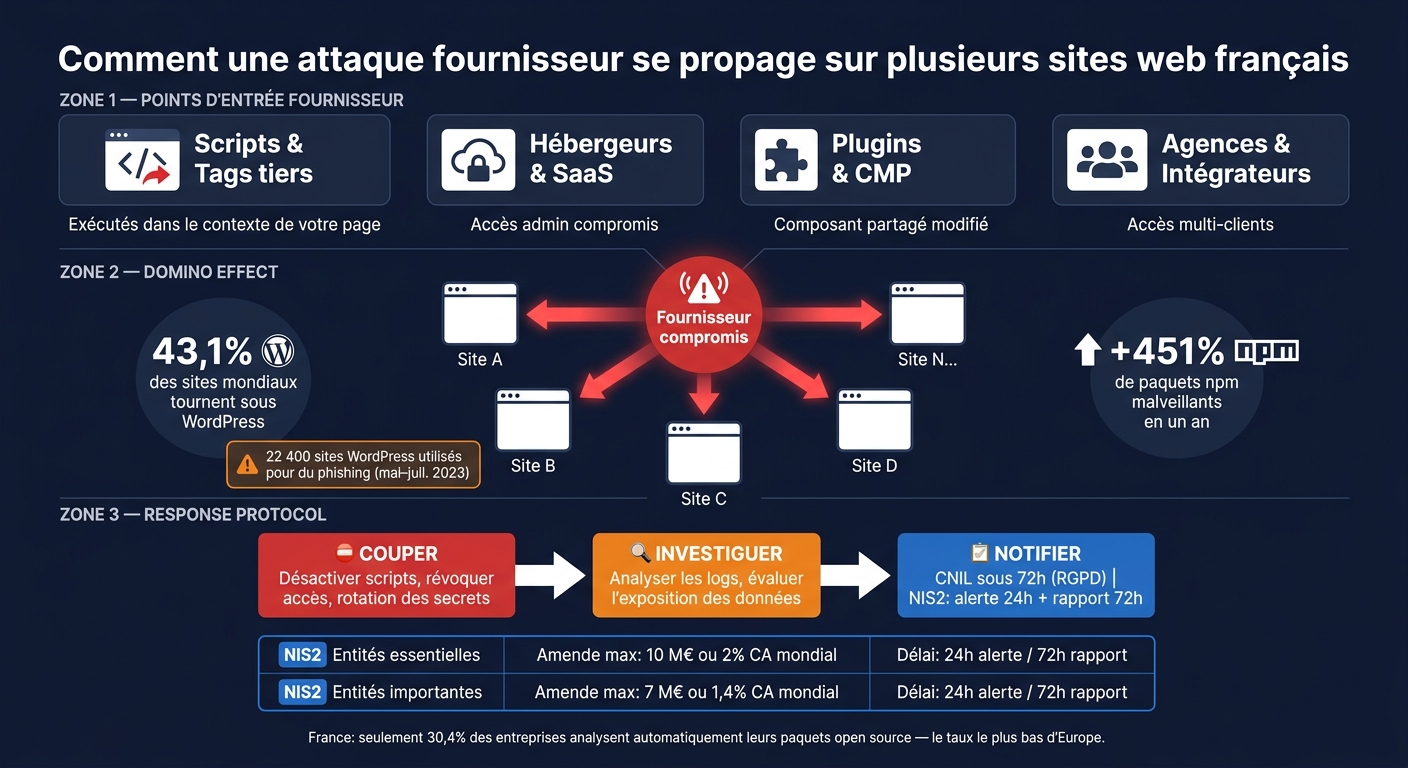 {Supply chain attack: how one compromised vendor hits multiple French websites}
:::
{Supply chain attack: how one compromised vendor hits multiple French websites}
:::
In practice, a compromise often starts with scripts, SaaS access, or technical providers and then spreads to the sites that depend on them. The objective changes little from one incident to the next: steal personal or payment data, redirect visitors, or install persistent access across several websites.
The most common entry points are embedded scripts, SaaS tools, and providers that manage several clients.
A third-party script loaded on your website runs in the context of your page. In other words, if that script is modified at the supplier, the malicious version immediately reaches every site that loads it, without any action on your side.
The first signals can often be spotted in the browser and in network traffic. For example:
This is far from a minor issue. In France, only 30.4% of companies use automated tools to analyse open-source packages, the lowest rate in Europe [1].
The same mechanism applies to services with broader rights in your environment. When an external tool can read, write, or administer, the risk rises sharply.
Services with administrator access to your environments are equally direct attack vectors. Sometimes, very little is needed: a stolen credential or a vulnerable component may be enough to open the door.
The alert published by WordPress on 20 July 2026 about “wp2shell” illustrates the problem: a single shared component can expose thousands of sites [2].
The result is a domino effect. If the same provider administers several websites, one compromise can multiply the impact within minutes.
A web agency or integrator managing several client websites can become a propagation point if its access is compromised. Each supplier access must therefore be limited to what is strictly necessary. Otherwise, a compromised account at a multi-client provider can move from one client site to another without any additional barrier.
At that point, the problem is no longer purely technical. When a provider manages several websites, the impact is simultaneous, harder to attribute, and much more difficult to contain.
An attack that comes through a supplier does not affect only one website. It can expose data, interrupt a service, and trigger notification obligations. Once the technical entry point has been identified, the issue is no longer limited to IT. It also becomes legal, operational, and organisational. And when the same supplier affects several French websites, the impact is as regulatory as it is technical.
If personal data is exposed through a compromised supplier, the organisation remains responsible under the GDPR. It must then notify the CNIL within 72 hours. For entities covered by NIS2, supplier risk adds another layer of obligations: an alert within 24 hours, followed by a report within 72 hours.
The table below summarises the key points:
| Framework | Sectors concerned | Maximum fine | Notification deadline |
|---|---|---|---|
| NIS2 (Essential entities) | Energy, healthcare, transport… | €10m or 2% of worldwide turnover | 24 h (alert) / 72 h (report) |
| NIS2 (Important entities) | Food, waste, postal services… | €7m or 1.4% of worldwide turnover | 24 h (alert) / 72 h (report) |
This framework clearly changes the situation. A supply-chain attack is no longer just an incident to handle internally. It is also an event to report, document, and explain to the authorities.
In practice, everything depends on one simple point: quickly identifying whether the compromise came from a supplier.
Some signals appear in the browser or on the network. Others show up in access logs or through security alerts. The most common ones to monitor, directly linked to the vectors mentioned above - scripts, supplier accounts, SaaS integrations, and hosting - are:
As soon as one of these signals appears, isolate the supplier concerned and check its access. These blind spots can delay detection. They should therefore trigger an immediate review of supplier accounts, scripts, and integrations.
Once the suspected supplier has been identified, it is time to act. In practice, everything rests on three workstreams: map, put controls in place, and monitor over time. In other words, know your dependencies, set controls when a supplier is integrated, and maintain a clear view of the SaaS tools in use.
IT teams often underestimate the number of active dependencies on their websites. Between scripts, tags, the CMP, hosting, agencies, and integrators, a site's exposure surface is often broader than expected.
The inventory should cover two levels: direct suppliers and their tier-two subcontractors. This mapping helps identify concentration risks and single points of failure [4][3]. For each supplier, document:
This overview can then be used to remove unnecessary access and prioritise supplier reviews.
A supplier integrated without prior checks quickly becomes a governance gap. Before onboarding, conduct a security, compliance, and access review. Also require the relevant evidence: a right to audit, MFA for privileged access, and a GDPR DPA when personal data is processed.
The work does not stop once the supplier is connected to the information system. After integration, controls must continue: access reviews, monitoring of certifications such as ISO 27001, SOC 2, or HDS for health data, and automatic alerts when a certification expires [4].
| Supplier type | Main attack vector | Controls to require |
|---|---|---|
| Ad tech / Scripts | Malicious script injection | Content Security Policy (CSP), Subresource Integrity (SRI) |
| Hosting / Cloud | Misconfiguration, data leak | ISO 27001, SOC 2 Type II, proof of data residency |
| SaaS tools | Unauthorised data export | SSO, access logs and RBAC roles, GDPR DPA |
| Agencies / Integrators | Abuse of privileged access | MFA, access logs, contractual right to audit |
As the number of suppliers grows, manual tracking eventually reaches its limits. This is where a centralised view becomes valuable.
Manual tracking does not scale. To follow these dependencies over time, Avanoo centralises suppliers, SaaS usage, and governance gaps.
In practical terms, Avanoo brings together SaaS application discovery, Shadow IT, and supplier security posture. CIO and CISO teams can monitor each tool continuously and generate GDPR and NIS2 reports.
| Method | Visibility | Automation | GDPR / NIS2 alignment |
|---|---|---|---|
| Manual | Low | None (static) | Insufficient (reactive) |
| SSO alone | Medium (misses Shadow IT) | High | Partial (misses scripts and extensions) |
| Avanoo | High (includes Shadow IT) | High (real time) | Strong (NIS2, GDPR) |
When a shared supplier is compromised, stop the attack immediately. In practical terms, disable suspicious scripts, tags, SaaS integrations, or supplier access, revoke the supplier's access, then rotate all related secrets and passwords. The order matters: cut access first, then rotate secrets without delay. Once the entry point is blocked, move straight to log analysis and an assessment of the exposure.
These three steps follow one another immediately. No pause, no detour.
| Phase | Key action |
|---|---|
| Containment | Disable suspicious scripts and integrations, revoke supplier access, rotate secrets and passwords |
| Investigation | Check code integrity, analyse logs, assess exposure of personal or banking data |
| Notification | Alert the CNIL within 72 hours if personal data was exposed. For covered entities, follow the NIS2 notification timetable. |
The principle is simple: first limit the damage, then understand what happened, and finally notify within the required deadlines. If personal data was exposed, the CNIL must be notified within 72 hours. If your organisation falls within NIS2, you must also follow its notification timetable.
After remediation, simply putting the website back online and moving on is not enough. Address the root cause to prevent another compromise.
When several sites are affected by the same shared supplier, access and dependencies must be addressed at the same time. Otherwise, you patch one breach while another remains open elsewhere.
After the incident, remember to:
This is often where the outcome is decided. A compromised supplier can become the same weak point across several websites at once. It is better to clean up the existing estate, control access, and monitor providers closely.

Shadow AI Expert & Chief AI Officer
Olivia Dubois is Shadow AI Expert and Chief AI Officer at Avanoo. An HEC Paris graduate and former BCG consultant, she helps enterprises detect and govern Shadow AI and Shadow IT.
See how Avanoo can map your SaaS and AI landscape, reduce risk, and optimize costs. A reliable platform with dedicated human support.
