

By Tanguy Duthion
·
May 30, 2026
Under DORA, I need to classify an ICT incident without delay, based on facts, and then check whether it reaches the major-incident threshold. In practice, I look at six criteria: affected customers and transactions, duration, reach within the EU, impact on data, effect on a critical or important function, and cost.
If I want to avoid a vague decision, I keep it simple:
In other words: no instinctive opinions. I start with measurements, such as 2 hours 15 minutes of unavailability, 2 EU countries affected, or an estimated loss of €80,000. Then I record, criterion by criterion, whether I am above, below, or uncertain.
Here is the key point at a glance:
| Point to decide | What I check |
|---|---|
| Customer impact | Number of affected customers and transaction volume |
| Downtime | Time between detection and full recovery |
| EU reach | Number of Member States concerned |
| Data | Availability, integrity, confidentiality, and authenticity |
| Affected service | Link to a critical or important function |
| Cost | Direct and indirect losses and SLA clauses |
| Dependencies | SaaS, ICT providers, and tools outside the inventory |
The simplest approach is to treat classification as a regulatory decision, with a timestamped file, evidence, assumptions, and any areas that remain uncertain.
Measure every criterion and retain the evidence that supports it. These elements are used to decide how the incident should be classified. This is not just a technical checkpoint.
Start by quantifying the number of affected customers, as well as the volume or value of disrupted transactions. To support this, use transaction logs, the CRM, and support tickets.
Duration is measured from the detection of the incident to the full restoration of the service. Then compare this period with your internal unavailability thresholds. For geographical reach, identify how many EU Member States experienced a service interruption. Regional status reports and network traffic logs can be used to verify this.
Assess four data-related dimensions: availability, integrity, confidentiality, and authenticity. If personal data is involved, also record any risk of a personal-data breach.
Then check whether the incident concerns a critical or important function and measure its direct effect on the business. The simplest approach is to cross-reference the asset register with the business impact analysis, or BIA, to confirm the impact under the applicable rules.
For the economic impact, clearly separate direct, indirect, and contractual costs. This point looks simple on paper, but in practice it is often where incident files become unclear.
| Cost type | Concrete examples | Evidence source |
|---|---|---|
| Direct costs | Lost revenue, remediation costs | Invoices, timesheets |
| Contractual penalties | Triggered SLA clauses | Contracts, SLA penalty clauses |
| Indirect costs | Lost productivity, delayed billing, commercial impact | Financial reporting, business indicators |
These measurements can then be compared with your internal DORA thresholds.
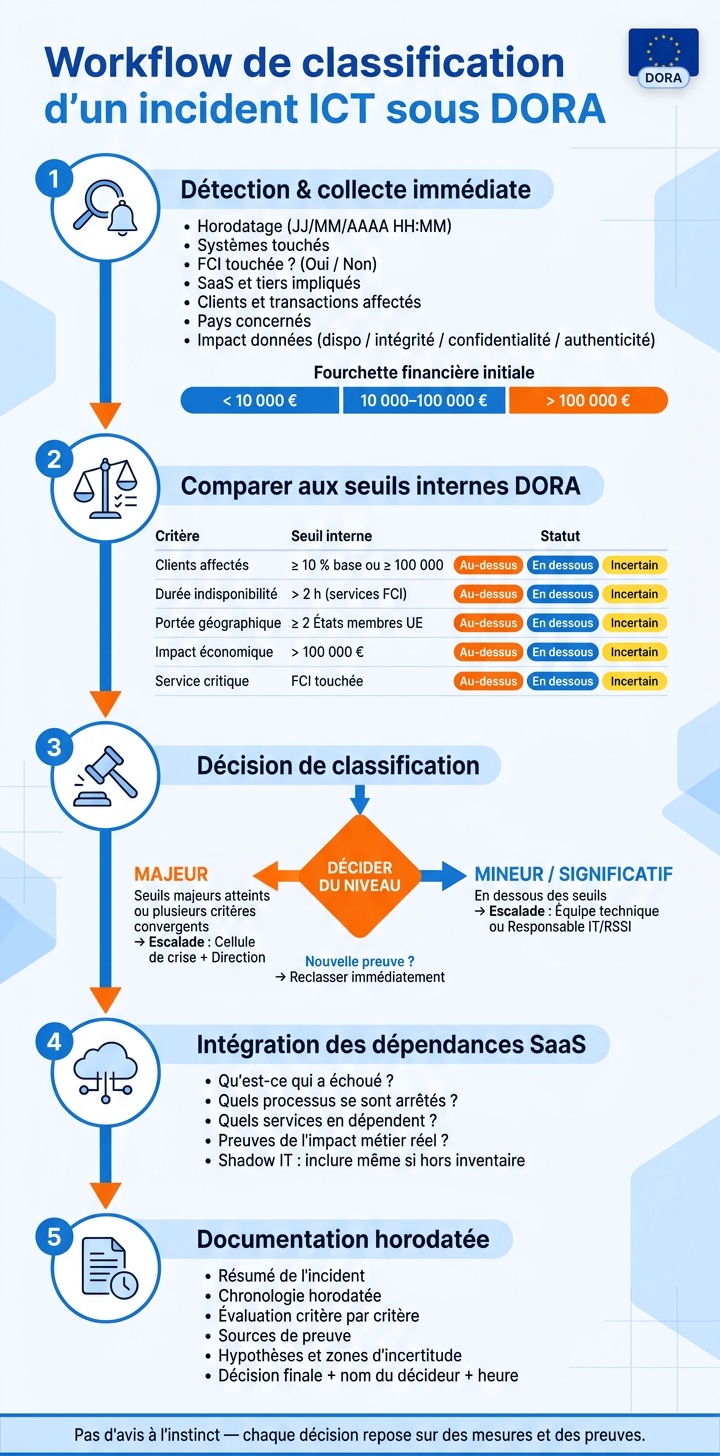
As soon as an incident is identified, collect the information needed for classification. The simplest approach is one structured form for each DORA criterion.
The form should include: a timestamp in the format DD/MM/YYYY HH:MM (Paris time, estimated or confirmed), identifier, reporter, affected systems, whether a critical or important function is affected, SaaS and third parties involved, affected customers and transactions, countries concerned, impact on data - availability, integrity, confidentiality, and authenticity - as well as an initial financial range in euros, for example “< €10,000”, “€10,000-€100,000”, or “> €100,000”.
Each field directly supports a DORA materiality criterion.
These data points can then be compared with the internal thresholds.
Once the form is complete, compare each metric with your internal threshold matrix aligned with the DORA RTS. The reference internal thresholds are: more than 10% of daily transactions or more than 100,000 customers affected, unavailability of more than 2 hours for services supporting a critical or important function, a geographical impact covering at least two EU Member States, and direct and indirect losses likely to exceed €100,000. [1][7]
| DORA criterion | Observed metric | Internal threshold | Status |
|---|---|---|---|
| Affected customers | 8,200 customers | ≥ 10% of the base or ≥ 100,000 | Uncertain |
| Duration of unavailability | 2 hours 15 minutes | > 2 hours for services supporting a critical or important function | Above |
| Geographical reach | France, Germany | ≥ 2 EU Member States | Above |
| Economic impact | ~€80,000 (initial estimate) | > €100,000 | Uncertain |
| Critical services affected | Not confirmed | Critical or important function affected | Uncertain |
For each criterion, assign a simple, clear status:
Also record who performed the assessment and at what time.
From this point on, the classification decision is no longer vague. It becomes concrete, almost mechanical.
The decision belongs to the incident manager, with the SOC, business, and compliance teams involved according to your governance model. [2][4][5][6] The incident is major if the major-incident thresholds are reached, or if several criteria point in the same direction. Otherwise, it remains minor or significant, depending on your internal thresholds. [8][3][7]
If new evidence changes whether a threshold has been crossed, reclassify without delay. Record the time and the decision-maker's name each time.
The analysis must then account for SaaS dependencies in the overall impact.
Once the DORA criteria have been quantified, check whether a SaaS application or provider increased the actual impact. Classification must not stop at the service visible on the surface. It must also account for the dependencies that keep it running: SaaS, IAM, collaboration tools, payment, support, and outsourced monitoring. If one of these links fails, customer-side workflows, reporting, or operations may deteriorate, even if the incident initially appears limited. [10]
Shadow IT adds another blind spot. An application absent from the catalogue may still support a very real business process. Its absence from the inventory does not change the impact in the field. In other words, the assessment must start from what actually happened, not simply from the application's registration status. [9][11][12]
For every SaaS service involved, ask four simple questions:
Also add a point of context: is the service internal, outsourced, or integrated into a third-party chain? And what exactly is its role: critical, supporting, or non-critical service?
When dependency mapping is reliable, the decision is often faster. Avanoo helps identify unrecorded usage, map SaaS dependencies, and connect affected data flows to the incident, including when some tools do not appear in the official inventory.
The classification decision must be written, structured, and defensible in an audit. In plain terms, it needs to leave a clear record, not a collection of scattered notes. The file should include an incident summary, a timestamped timeline, affected functions, a criterion-by-criterion assessment, evidence sources, assumptions, remaining areas of uncertainty, and the final decision with its reasoning. Also state who decided, who approved, and at what time. [13]
You can formalise all of this in an evidence table.
Table 1 - observed metrics and evidence
| DORA criterion | Observed value | Internal threshold | Evidence source | Assessment |
|---|---|---|---|---|
| Duration of unavailability | to be completed | Internal threshold for a critical service | System logs | - |
| Affected customers | to be completed | Internal threshold for affected customers | SSO / IdP logs | - |
| Geographical reach | to be completed | Impact across several EU Member States | Regional server logs | - |
| Impact on data | to be completed | Integrity or confidentiality affected | DLP alerts | - |
| SaaS service criticality | to be completed | Critical or important function | Asset register / BIA | - |
| Economic impact | to be completed | Internal euro threshold | Initial financial estimate | - |
Table 2 - internal level and escalation
| Internal severity level | Required escalation |
|---|---|
| Low | Technical team |
| Medium | IT manager / CISO |
| High / Major | Crisis team + management |
Classifying an ICT incident under DORA requires a decision supported by measurable facts. Each criterion must be examined separately, with evidence to support it.
The same logic applies to SaaS dependencies and third-party providers. If a SaaS or third-party service supports a business process or critical service, it must be included in the impact analysis. In short, if you do not have a clear view of these dependencies, your classification may start from the wrong assumptions.
In practice, the method rests on four simple actions.
This framework helps produce a consistent, traceable, and defensible decision. It also puts IT, security, compliance, finance, and procurement on the same page.
::: faq
Under DORA, an ICT incident is classified as major if it exceeds at least two criteria. These may include the number of affected customers, the duration of the outage, geographical reach, data loss, service criticality, or economic impact.
It can also be classified as major in two other specific cases. First, if there is unauthorised malicious access to critical systems. Second, if recurring minor incidents linked to the same cause occur at least twice within a six-month period. :::
::: faq
With incomplete information, classify the DORA incident cautiously, but without delay. As soon as it is detected, appoint a team to take charge and start the analysis immediately. The key point is simple: the initial four-hour notification deadline starts when the incident is classified as major.
To move forward in the right conditions, rely on:
If some criteria are not yet settled, document every action taken and update the classification as soon as more precise data becomes available. :::
::: faq
Including SaaS and Shadow IT is essential for DORA compliance. Why? Because they are often the source of the largest blind spots in the information system.
Without an overall view, it becomes difficult to keep the ICT provider register up to date and, as a result, assess supply-chain risks.
The problem is straightforward: an unlisted tool can create security weaknesses, poorly governed data processing, and much more complicated incident management. When an incident has to be notified, every unclear area becomes a constraint.
Detecting and documenting these tools makes it possible to map each critical service more accurately. You are no longer working blindly. You are using concrete data to support digital resilience. :::

Co-fondateur & CEO
Tanguy Duthion is co-founder and CEO of Avanoo. Previously at Google and Asana, he founded Avanoo to help organizations regain control over their SaaS and AI usage.
See how Avanoo can map your SaaS and AI landscape, reduce risk, and optimize costs. A reliable platform with dedicated human support.
